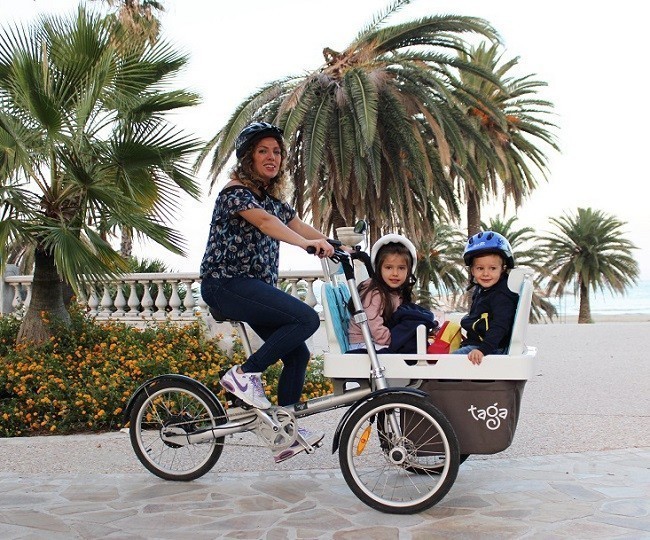
Bicycle seat: from harnesses to footrests and other essential components and features for child safety when cycling

Bicycle seat
For the safety of children transported by bicycle, the quality and characteristics of the bicycle seat is of utmost importance and therefore it is essential to follow certain rules and regulations in this regard.
First of all, children can be transported in a bike seat from 12 months (9 months after consulting the doctor). The exception is only in specially designed child seats mounted on a special bike, such as the baby carrier where it is possible to transport a child from as early as 0 months (see TAGA FIRST MONTHS), the TAGA child seat is suitable for transport from 6 months (see TAGA Bike and the Infant seat for TAGA Family).
There are 2 seat positions,
in front (Contrary to what is commonly known, this is the safest position for the child as the parent has physical and visual control over what happens to the child, so younger children (up to 15 kg) are carried in a child seat in this position. The bike seat is attached not on the handlebars, but on the fixed part of the frame. Because of its proven safety, the front position is also used primarily (for the first 2 children) for TAGA BIKE bike seats, the TAGA bike seat is additionally protected by the reinforced handlebars, which are specially and appropriately divided to accommodate 1 or 2 children safely for a total weight of up to 70 kg.
behind to the driver. In this case the seat can carry up to 22 kg. In this position the driver has no control over the child and cannot see the child. The position also does not offer the child good visibility and they are wont to protest when over 15 kg are moved to the rear. The attachment of the rear seat can either be on top of the carrier or attached directly to the seat tube.
Important: The front and rear child seat may not be placed in a position other than the one for which they were designed. In addition, it is not possible to attach 2 child seats to one bicycle with the exception of bicycles that are specially constructed for transporting several children. In this case the bike seat will only be made by the manufacturer for the bike for which it is intended.
With regard to child seats, the European standard EN 14344 is in force in Italy, which describes the characteristics of a bicycle seat in order to be in compliance.
A bicycle seat designed to be placed on any bicycle (i.e. not just one for which it is intended) must have the following marking:
“C 15” for front seats up to 15 kg;
“A 22” for rear seats up to 22 kg;
there is also “A15” for rear seats up to 15 kg, - but it is an almost unused type of seat.
In addition, the seat must consist of the seat with:
BACKPACK (a good seat offers a reclining backrest, back support and perhaps even a headrest, which are important for physiological sitting without having to contract the child's back and neck muscles),
BRACELETS very important to be able to hold on and not cling to the driver, especially during some turbulence.
FOOTSTEPS important for support and so that the child's feet do not end up in the spokes of the bicycle, a situation that is unfortunately very common with bad consequences.
SEAT BELT best multi-point, between the safest three-point and five-point buckles. The buckle should not be easy for the child to unbuckle. The belt should be height-adjustable to provide greater safety.
ANCHORAGE SYSTEM which must be robust.
ImportantThe bicycle seat must not exceed the contour of the bicycle. The child carried must not obstruct the driver's good visibility or unbalance him/her. The ends must be rounded to limit the risk of injury and the child seat must not have easily detachable and swallowable parts.
10 reasons why the TAGA bike seat is safer?
1. Bicycle: 3-wheeled, stable yet slim, the TAGA is one and only bicycle created specifically for transporting children, every detail designed for maximum safety and comfort for the family.
2. FixingIt was created ONLY for TAGA and not to be compatible with any bicycle on the market, which made it possible to create an ultra-safe and strong attachment.
3. Protection: The frame of the seat in the TAGA PASSEGGINO model and of the basket in the TAGA FAMILY model is made of metal and ultra-resistant plastic to absorb any impact and protect the children as much as possible. In addition, children are protected by the reinforced, specially divided handlebar.
4. BackrestThe seat has a long backrest and an ergonomic seat. The TAGA BICI model has upholstered seats, the TAGA FAMILY model has a comfortable backrest with adjustable headrest, a padded and ergonomic baby seat cover is available, the seats of both models are reclining and covered with a washable fabric.
5. Seat beltHeight-adjustable, 5-point height adjustment for the TAGA PASSEGGINO model and 3-point height adjustment for the TAGA FAMILY model.
6. Child positionFront for the first 2 children, rear for the third child. If desired, up to 5! children can be transported on the rear trolley at the same time.
7. ArmrestsTAGA has a convenient hand bar that the child can comfortably hold onto. This also contributes further to the safety of the child (as it is reinforced), and baby toys, baby bottles or water bottles can be attached to it.
8. Footrest: The TAGA seat provides children with comfortable support, the child's legs are protected both from being caught between the spokes of the wheels and from being knocked over.
9. Number of children: In TAGA you can transport from one up to five children: two in the TAGA front seats, one in the rear seat, two more in the rear carrier.
10. Age of children: Thanks to the child seat attachment and the bike's stability, the TAGA is the only bike in which children can be transported from as early as 0 months! The maximum age of children that can be transported on the TAGA is 9 years (maximum total weight in front 70 kg) until they are not only capable of riding a bike, but become so able and conscious that they can accompany you on their bike while keeping up and without having to worry about their safety even in traffic. Because the bicycle is the most effective means of urban transport!
ImportantIn TAGA, the child does not obstruct the driver's view or affect his or her balancing ability (not required as a stable and safe three-wheel bicycle).