Folding electric bicycle for transporting children

Folding electric bicycle for transporting children
The electric and folding bicycle is spoiling the world of cycling, but will be suitable for transporting children?
It is a very practical solution, especially if you leave by car with your bike on board and later reach your destination by bike, notice without breaking a sweat: the electric and folding bike is an evolution of mobility, the answer to cities choked by smog and the need to reduce traffic, close the centre to traffic and create pedestrian zones in the most beautiful places such as the waterfront, riversides and parks.
However, it is safe to transport children on a folding bike? When it comes to folding two-wheelers, I personally have a lot of doubts, which have yet to be clarified. One thing is certain, the front seat for children up to 15 kg cannot be installed on the folding bike (my 3.5-year-old son weighs about 13 kg).
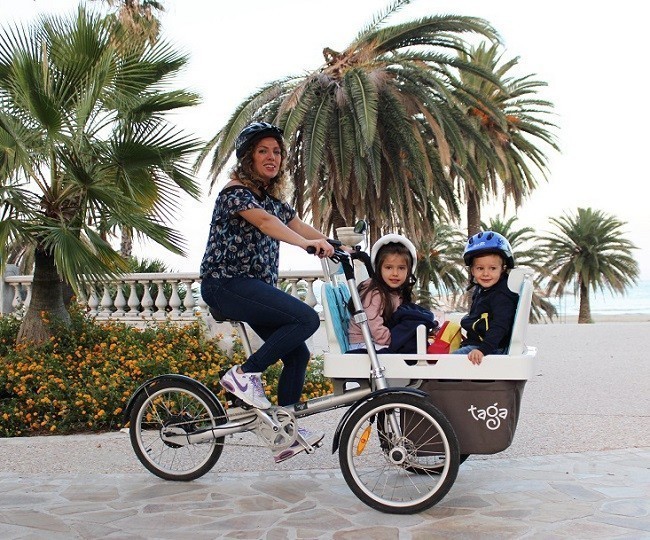
The situation changes, of course, when it comes to a folding electric bicycle SPECIFICALLY CREATED for transporting children, which is also perfect for transporting pets and cargo, i.e. a FAMILY BIKE or a folding CARGOBIKE.
It doesn't exist, some will say, and they will be wrong, not only does it exist but it has existed for some time now, since 2008 with the release of the TAGA BIKE pram model and the more recent release of the FAMILY BIKE model.
But let us speak in order, characteristics from e-bike or electric bicycle.
European regulations set clear limits for the electric bicycle, EU standart pedelecmax. speed 25 km/h, max. power 250 W, assisted pedalling and not fully electric, i.e. the action of the motor must be combined with a slight movement of the legs.
These are the European standards that the law imposes on us, let's see what features we can choose from instead.
Motor positioning
can be on the front or rear wheel, much rarer, the centre position. Although the central location certainly has its advantages, for example to change a wheel where the motor is located you do not first have to disconnect the motor cable, as with the other two solutions. The biggest disadvantage of central positioning is that the bicycle frame must be prepared for the motor and therefore it is not possible to mount the motor after it leaves the factory; it is also the most expensive solution.
Positioning in the front wheel is the simplest solution in terms of assembly, but also the most inadvisable as it can create some difficulty in riding the bike due to both the imbalance in weight distribution and the change in traction, which is naturally at the rear of the bike. In addition, in the event of rain, there is a risk of losing grip when riding uphill or on dirt roads.
In our opinion the rear position is the most effective and practical, it is slightly more complicated in the initial assembly, but the only real disadvantage is having to disconnect the cable before changing the wheel. In terms of performance, however, it is definitely the best solution.
Battery
is the most important component of the entire electrical kit, the best are at lithium while lead-gel and nickel-metal hydride also exist. OK, fine, but why are lithium batteries considered the best compared to the other 2 solutions? Simple! They are much lighter, quicker to charge, do not pollute and do not require maintenance during temperatures below - 5°C and above + 30°C, so up to - 20°C and up to + 50° we can be comfortable; considering climate change and if we don't do our own (e.g. prefer the bike to the car where and when possible) for about another 5 years.
Capacity
measured in Watt-hours, Wh indicates the energy delivered to the motor and is calculated by multiplying the voltage, V, by the current intensity per hour, Ah. Below 360 Wh it is considered low, above 450 Wh high.
Autonomy
very difficult to calculate as it depends on many factors including the weight of the bike, rider and load, gradient, type of terrain and level of assistance. It also changes as the battery ages, the life of which lasts about three years. Thus, under 50 km is considered low, from 50 to 80 km medium and from 80 to high.
The efficiency of the’pedalling assistance depends on the number of levels, below 3 is low, above 5 high.
On-board computer
allows you to choose the level of assistance and state of charge, in more expensive versions they may also have a km counter, power setting, integrated GPS, etc...
Often there are hybrid solutions that combine the on-board computer with an app to download. In this case, the presence of a mobile phone holder on the handlebar is important.
Folding bicycle
instead it must be light. A 2-wheel bike is considered light if it weighs less than 20 kg, medium up to 28 kg and heavy with the heaviest weight. Just think that the TAGA pram bike weighs 19 kg, while the TAGA FAMILY weighs 22 kg, and these are the three-wheel bikes that can comfortably transport up to 3 children!!!
The size of the wheels
affects not only the compactness but also the comfort and speed of the bike: the larger the wheels, the more comfortable and faster the bike (applying the same effort), while the smaller the wheels, the more compact the bike will be when folded. As they say, you need a compromise between compactness, comfort and speed. Wheel size is most often measured in inches and can vary from 12” to 29”, the classic city bike has 28” wheels. In order to choose the right one for one's needs, one must therefore ask oneself the length of the route to be covered and how often one will need to close the bike. Obviously, if one intends to commute by car and cycle a short distance, several times a day, a bicycle with small wheels and vice versa is more appropriate.
In addition, the size of the wheels and the structure of the bicycle itself, especially a folding bicycle, affect safety when transporting children. Most folding bicycles on the market do not allow the fitting of a front seat, would all folding bicycles, but...
And here the genius of TAGA emerges! Foldable and electrically powered, it was specially created for transporting children. It can safely transport up to three children from 0 to about 9 years old, and is comfortable to ride even for people 2 metres tall.
The TAGA BICI pram has 16” wheels because, in addition to being foldable, it also converts into a pushchair, while the TAGA FAMILY has 20” wheels, which makes it compact, but also quite fast, especially in the e-bike version, reaching the maximum permitted speed of 25 km/h in just a few tens of seconds.
Learn more about the TAGA electric folding bike!